


PhD Success!
Congratulations to John (Jack) Salvesen on successfully completing his PhD viva, defending his thesis titled Interaction Point Feedback Systems for High-Luminosity Circular Lepton Colliders.
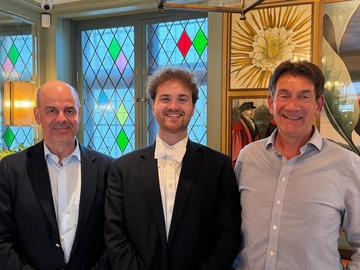
Emmanuel Tsesmelis (examiner), John (Jack) Salvesen, and Philip Burrows (supervisor)
Jack’s research focused on one of the key challenges facing future high-luminosity lepton colliders: how to keep two colliding beams aligned with nanometre-scale precision.
This level of control is essential for machines such as CERN’s proposed Future Circular Electron–Positron Collider (FCC-ee), where even small dynamic orbit fluctuations from ground motion, magnet vibrations or beam–beam effects can reduce the delivered luminosity.
His thesis developed analytic and simulation tools for the design and optimisation of fast interaction point feedback systems.
These systems use beam-based measurements to actively correct the relative beam position at the collision point and help preserve luminosity during operation.
The work included a new analytic framework for multi-interaction-point circular colliders, as well as large-scale beam–beam tracking simulations.
Jack also studied the iBump beam–beam deflection feedback system at SuperKEKB, an operating high-luminosity lepton collider in Japan.
Using both operational machine data and Xsuite-based simulations, he investigated the stability, tuning and correction behaviour of the system.
These studies provided valuable insight into the practical implementation of interaction point feedback in a real collider environment.
For FCC-ee, Jack evaluated feedback performance under both idealised perturbations and realistic models of final-focus quadrupole vibrations.
The results demonstrated that appropriately optimised interaction point feedback can significantly mitigate dynamic orbit perturbations and help preserve luminosity under realistic disturbance conditions.
Jack has now joined CERN as a Computational Physicist and research fellow in the Beams Department, Accelerator Beam Physics group, Computational Accelerator Physics section (BE-ABP-CAP).
His current work focuses on FCC-ee, SuperKEKB and the Accelerator Models optics repositories.

